




Quantum computing is no longer a far-off idea. It is happening now. And Finland is leading the way in Europe. With advanced technology, strong research, and international partnerships, Finland is building some of the most advanced quantum computers in the world.
From the first 5-qubit system to Europe’s first 50-qubit computer and upcoming 150- and 300-qubit systems, Finland is moving quickly.
This article explains how Finland became a leader in quantum technology, the key companies involved, the role of supercomputers, and why businesses and researchers should pay attention.
Key Takeaways
- Finland launched Europe’s first 50-qubit quantum computer.
- Key players include IQM, SemiQon, Algorithmiq, Bluefors, and Quanscient.
- 150- and 300-qubit systems will strengthen Finland’s global leadership.
- Integration with supercomputers (LUMI) enhances computing capabilities.
- Finnish startups and the BusinessQ community expand the ecosystem internationally.
- Quantum-safe encryption ensures secure future digital systems.
- Government and EU funding attract talent and accelerate innovation.
The Quantum Era in Finland – An Overview

Quantum computing uses the principles of quantum physics to solve problems that traditional computers cannot. Imagine a maze so complex that even the fastest supercomputer would take centuries to solve. A quantum computer could find the solution in minutes by exploring all paths at the same time.
Finland has invested heavily in quantum technology. Since 2020, the government has provided funding to support research, startups, and international collaboration. The Finnish Quantum Flagship (FQF) program in 2024 added €13 million to attract global talent.
Quantum computers can help in many areas, including medicine, materials science, artificial intelligence, cryptography, and industrial optimisation.
History of Quantum Computing in Finland
Finland’s journey in quantum computing began with early research at universities like Aalto University and the University of Helsinki, focusing on quantum mechanics, algorithms, and superconducting systems. Government funding and initiatives in the 2010s helped build a strong foundation for talent, research, and innovation, setting the stage for practical applications.
By 2021, Finland had developed its first 5-qubit system, followed by a 20-qubit system in 2023. These milestones paved the way for Europe’s first 50-qubit quantum computer in 2025, reflecting the country’s strategic investment and growing role as a European leader in quantum technology.
Flagship Quantum Systems in Finland
Finland’s quantum journey is more than just research. It’s about building powerful machines that can solve problems faster than ever. Let’s explore the flagship quantum systems that are putting Finland at the forefront of global quantum computing.
50-Qubit Quantum Computer – Europe’s First
In March 2025, Finland unveiled Europe’s first 50-qubit quantum computer, developed by VTT Technical Research Centre of Finland and IQM Quantum Computers. This system is available to researchers and businesses through the VTT QX quantum computing service.
The 50-qubit computer is part of a phased development:
- 2021: 5-qubit system
- 2023: 20-qubit system
- 2025: 50-qubit system
150- and 300-Qubit Superconducting Systems – The Future of Hardware
Finland is not stopping at 50 qubits. IQM Quantum Computers has partnered with VTT to build larger systems:
- 150-qubit system: Expected by mid-2026
- 300-qubit system: Expected by late-2027
Leading Finnish Quantum Companies and Their Roles
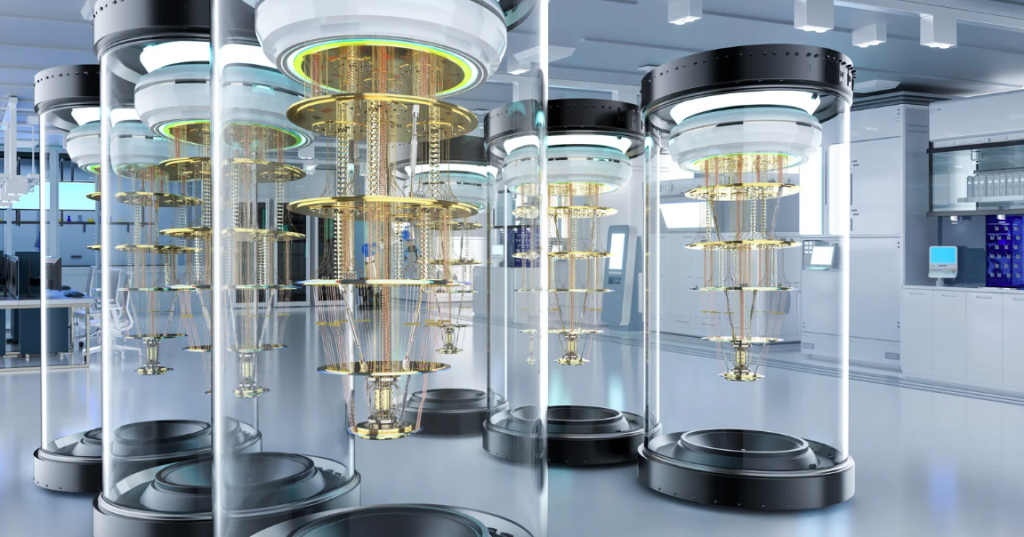
Behind Finland’s quantum success are companies turning research into real-world solutions. Let’s meet the leading Finnish quantum companies driving hardware, software, and infrastructure innovation.
IQM Quantum Computers – Hardware Pioneer
Based in Espoo, Finland, IQM builds superconducting quantum computers and full-stack systems. The company has raised over €200 million and operates in nine countries. IQM is also deploying quantum computers globally, including Japan, Poland, and the United States.
SemiQon – Silicon-Based Quantum Processors
SemiQon is a VTT spin-off developing silicon-based cryogenic CMOS processors. These are more scalable, affordable, and energy-efficient than traditional superconducting systems.
SemiQon secured €17.5 million from the European Innovation Council, allowing it to accelerate global commercialisation. Its technology could also be used for secure satellite communications.
Algorithmiq – Quantum Software and Algorithms
Algorithmiq specialises in quantum algorithms, especially for drug discovery and life sciences. Its Aurora platform, developed with IBM, combines quantum and classical computing for more accurate, scalable solutions.
Algorithmiq raised €13.7 million in 2023 and partnered with NVIDIA in 2025 to integrate supercomputing acceleration into its quantum software.
Bluefors – Cryogenic Infrastructure
Bluefors, headquartered in Helsinki, makes ultra-low temperature cryogenic systems needed to keep qubits stable. Its systems are essential for both research and industrial quantum computers.
Bluefors has expanded globally, including in the USA, and launched a Lab-as-a-Service model, giving companies access to advanced cooling technology without full ownership.
Quanscient – Cloud-Native Quantum Simulation
Quanscient builds a cloud-based quantum simulation platform for engineering. Its platform integrates multiphysics solvers, advanced cloud computing, and quantum algorithms. It allows engineers to run simulations up to 100 times faster than traditional tools.
Quanscient raised €5.2 million in 2024 and became the first company to run Computational Fluid Dynamics (CFD) simulations on real quantum hardware.
Other Startups and Ecosystem Players
Finland’s BusinessQ community now includes over 25 companies working across the quantum value chain, such as Arctic Instruments and SemiQon spin-offs.
Together, they form a robust quantum ecosystem supporting research, commercial applications, and international collaboration.
Integration with Supercomputers
Quantum computers do not replace traditional supercomputers. Instead, they work together. A quantum computer handles problems suitable for quantum methods, while a supercomputer manages control, interpretation, and classical calculations. This combination creates quantum-accelerated high-performance computing.
In Finland, the LUMI supercomputer and VTT’s Helmi/50-qubit quantum computer were integrated in 2022. This was the first time in Europe that a universal quantum computer connected to a supercomputer was available to researchers. Scientists and businesses can access these systems through proposals submitted to the LUMI supercomputer.
Finland is also involved in international collaborations, including:
- FiQCI: Finnish Quantum Computing Infrastructure
- NordIQuEst: Developing Nordic quantum computing capabilities
- OpenSuperQ+: 28 European partners working on a 1,000-qubit quantum computer.
Quantum computing and AI
Quantum computing has the potential to transform artificial intelligence by dramatically speeding up data processing and complex computations. By leveraging qubits and quantum algorithms, AI models can be trained faster, optimized more efficiently, and handle problems that are too large or complex for classical computers.
In Finland, researchers and startups are exploring how quantum-enhanced AI can improve applications in drug discovery, materials science, finance, and advanced simulations, creating new opportunities for innovation across industries.
Government Policies and Funding
The Finnish government has played a key role in advancing quantum computing through targeted funding, grants, and strategic programs. Initiatives like the Finnish Quantum Flagship (FQF) provide millions of euros to support research, attract global talent, and accelerate startup innovation in both hardware and software.
At the EU level, Finland benefits from programs such as Horizon Europe and the European Innovation Council, which offer financial support for collaborative projects and international partnerships.
Tax incentives and public-private collaborations further encourage companies to invest in quantum technology, helping Finland maintain its competitive edge in the global quantum race.
Applications and Industry Impact
Quantum computing in Finland is being applied to:
- Material modelling: Faster and more accurate simulations for new materials.
- Artificial intelligence: Enhanced AI models and optimisation algorithms.
- Drug discovery: Using quantum algorithms to accelerate medicine development.
- Finance and cryptography: More secure and efficient computations.
- Space and satellite communications: Especially with silicon-based technologies like SemiQon.
Opportunities in Quantum Computing for Businesses and Researchers
Finland’s growing quantum ecosystem offers unique opportunities for businesses and researchers to explore cutting-edge technology and drive innovation:
- Access to Advanced Quantum Systems: Businesses can leverage 50-qubit and upcoming 150- and 300-qubit computers for research and development.
- Collaboration with Startups and Research Institutions: Partnerships with companies like IQM, SemiQon, and Algorithmiq provide expertise and technology access.
- Funding and Grants: Government and EU programs support projects, talent acquisition, and international collaboration.
- Integration with Supercomputers: Combining quantum computers with systems like LUMI allows complex simulations and accelerated computations.
- Commercial Applications: Opportunities exist in AI, drug discovery, materials science, finance, cryptography, and more.
- International Networking: Participation in initiatives like FiQCI and OpenSuperQ+ connects businesses and researchers to the global quantum community.
Quantum computing stocks to buy
Investing in quantum computing offers exposure to a rapidly growing technology sector with global potential. Key companies include Finland’s IQM Quantum Computers, SemiQon, and Algorithmiq, as well as international players like IBM, Google, and Rigetti, which are driving innovation in hardware, software, and quantum applications.
For investors, these stocks represent opportunities to participate in the early stages of a technology that could transform industries such as AI, cryptography, drug discovery, and materials science.
Challenges and Limitations of Quantum Computing
While Finland is leading in quantum computing, there are still technical, commercial, and practical challenges that must be addressed:
- Scalability of Qubits: Increasing the number of stable qubits without errors remains a major technical hurdle.
- Qubit Stability and Error Correction: Maintaining qubit coherence over time requires advanced cryogenic systems and error-correcting protocols.
- High Costs: Building and maintaining quantum hardware, including superconducting and silicon-based systems, is expensive.
- Talent Shortage: There is a limited pool of researchers and engineers with specialized quantum expertise.
- Integration with Classical Systems: Combining quantum computers with existing supercomputers and workflows is complex.
- Commercial Applications: Many quantum solutions are still in research or pilot stages, delaying wide industry adoption.
The Future of Quantum Computing in Finland:
Finland is set to expand its leadership in quantum computing with upcoming 150- and 300-qubit systems, enabling advances in medicine, AI, materials science, and cryptography. Strong government support, EU funding, and a growing ecosystem of startups and research institutions position Finland to shape the future of quantum technology globally.
Conclusion
Finland is emerging as a global leader in quantum computing, combining advanced hardware, software, and infrastructure with strong research and international collaboration. From the 50-qubit breakthrough to the upcoming 150- and 300-qubit systems, Finnish companies and startups are driving innovation across industries.
By integrating quantum computers with supercomputers, advancing quantum-safe encryption, and fostering a vibrant ecosystem, Finland is not just keeping pace with the global quantum race. It is shaping the future of technology. Researchers and businesses now have unique opportunities to explore this quantum frontier.